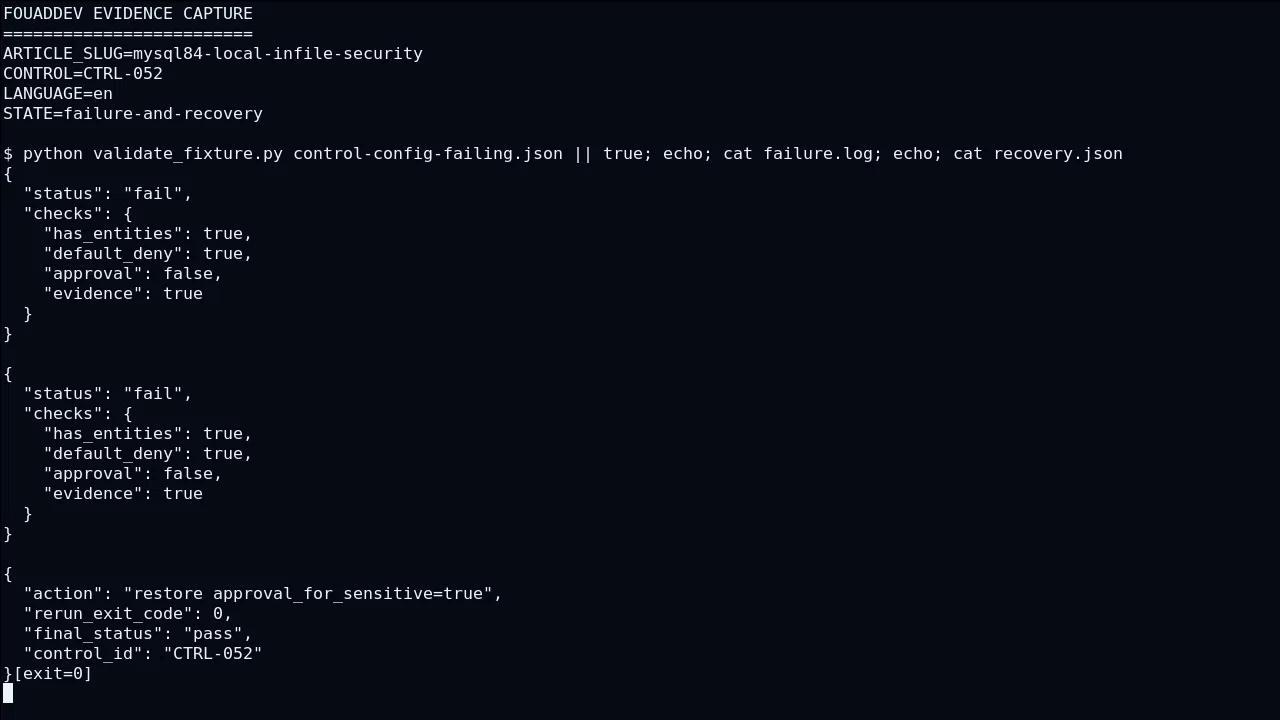
MySQL 8.4 local_infile: keep import convenience from becoming a file boundary problem addresses one concrete problem: Constrain file import behavior with server options, privileges and deployment assumptions rather than treating local_infile as a harmless toggle. The guide works from the actual objects — MySQL 8.4, local_infile, secure_file_priv, privilege, import — and aims for a verifiable decision rather than a generic pattern.
The concrete problem: MySQL 8.4 meets local_infile
A robust implementation separates what the model proposes from what the application authorizes and verifies.
In “MySQL 8.4 local_infile: keep import convenience from becoming a file boundary problem”, scenario mysql84-local-infile-security-c11 starts at local_infile and treats secure_file_priv as an explicit boundary rather than an implicit assumption. The first control requires privilege to emit an observable result before import can trigger the intended effect around MySQL 8.4. If the import verification fails, rollback restores the configuration around MySQL 8.4, replays mysql84-local-infile-security-c11, and compares the new state with the control evidence from local_infile. This detail makes “MySQL 8.4 local_infile: keep import convenience from becoming a file boundary problem” reviewable because each operational statement points to secure_file_priv, a concrete condition, and evidence instead of a generic assurance. The conclusion stays bounded by privilege and MySQL 8.4: anything not demonstrated by scenario mysql84-local-infile-security-c11 is labeled as a limitation or inference, never promoted to fact.
In “MySQL 8.4 local_infile: keep import convenience from becoming a file boundary problem”, scenario mysql84-local-infile-security-c12 starts at secure_file_priv and treats privilege as an explicit boundary rather than an implicit assumption. The first control requires import to emit an observable result before MySQL 8.4 can trigger the intended effect around local_infile. That sequence serves this concrete job: Constrain file import behavior with server options, privileges and deployment assumptions rather than treating local_infile as a harmless toggle. It turns secure_file_priv into a reviewable decision point with a named input and a retained output. To test privilege, fixture mysql84-local-infile-security-c12 contains both an allowed state and a rejected state; rejection must occur before any change attributed to import. Operations then observes the transition between import and MySQL 8.4, while security checks that local_infile receives neither implicit authority nor unnecessary data.
In “MySQL 8.4 local_infile: keep import convenience from becoming a file boundary problem”, scenario mysql84-local-infile-security-c13 starts at privilege and treats import as an explicit boundary rather than an implicit assumption. The first control requires MySQL 8.4 to emit an observable result before local_infile can trigger the intended effect around secure_file_priv. If the local_infile verification fails, rollback restores the configuration around secure_file_priv, replays mysql84-local-infile-security-c13, and compares the new state with the control evidence from privilege. This detail makes “MySQL 8.4 local_infile: keep import convenience from becoming a file boundary problem” reviewable because each operational statement points to import, a concrete condition, and evidence instead of a generic assurance. The conclusion stays bounded by MySQL 8.4 and secure_file_priv: anything not demonstrated by scenario mysql84-local-infile-security-c13 is labeled as a limitation or inference, never promoted to fact.
In “MySQL 8.4 local_infile: keep import convenience from becoming a file boundary problem”, scenario mysql84-local-infile-security-c14 starts at import and treats MySQL 8.4 as an explicit boundary rather than an implicit assumption. The first control requires local_infile to emit an observable result before secure_file_priv can trigger the intended effect around privilege. That sequence serves this concrete job: Constrain file import behavior with server options, privileges and deployment assumptions rather than treating local_infile as a harmless toggle. It turns import into a reviewable decision point with a named input and a retained output. To test MySQL 8.4, fixture mysql84-local-infile-security-c14 contains both an allowed state and a rejected state; rejection must occur before any change attributed to local_infile. Operations then observes the transition between local_infile and secure_file_priv, while security checks that privilege receives neither implicit authority nor unnecessary data.
Failure modes, signals, and diagnosis
The starting point is not a feature; it is an observable decision boundary.
In “MySQL 8.4 local_infile: keep import convenience from becoming a file boundary problem”, scenario mysql84-local-infile-security-c21 starts at secure_file_priv and treats privilege as an explicit boundary rather than an implicit assumption. The first control requires import to emit an observable result before MySQL 8.4 can trigger the intended effect around local_infile. Operations then observes the transition between import and MySQL 8.4, while security checks that local_infile receives neither implicit authority nor unnecessary data. If the MySQL 8.4 verification fails, rollback restores the configuration around local_infile, replays mysql84-local-infile-security-c21, and compares the new state with the control evidence from secure_file_priv. This detail makes “MySQL 8.4 local_infile: keep import convenience from becoming a file boundary problem” reviewable because each operational statement points to privilege, a concrete condition, and evidence instead of a generic assurance.
In “MySQL 8.4 local_infile: keep import convenience from becoming a file boundary problem”, scenario mysql84-local-infile-security-c22 starts at privilege and treats import as an explicit boundary rather than an implicit assumption. The first control requires MySQL 8.4 to emit an observable result before local_infile can trigger the intended effect around secure_file_priv. The conclusion stays bounded by MySQL 8.4 and secure_file_priv: anything not demonstrated by scenario mysql84-local-infile-security-c22 is labeled as a limitation or inference, never promoted to fact. That sequence serves this concrete job: Constrain file import behavior with server options, privileges and deployment assumptions rather than treating local_infile as a harmless toggle. It turns privilege into a reviewable decision point with a named input and a retained output. To test import, fixture mysql84-local-infile-security-c22 contains both an allowed state and a rejected state; rejection must occur before any change attributed to MySQL 8.4.
In “MySQL 8.4 local_infile: keep import convenience from becoming a file boundary problem”, scenario mysql84-local-infile-security-c23 starts at import and treats MySQL 8.4 as an explicit boundary rather than an implicit assumption. The first control requires local_infile to emit an observable result before secure_file_priv can trigger the intended effect around privilege. Operations then observes the transition between local_infile and secure_file_priv, while security checks that privilege receives neither implicit authority nor unnecessary data. If the secure_file_priv verification fails, rollback restores the configuration around privilege, replays mysql84-local-infile-security-c23, and compares the new state with the control evidence from import. This detail makes “MySQL 8.4 local_infile: keep import convenience from becoming a file boundary problem” reviewable because each operational statement points to MySQL 8.4, a concrete condition, and evidence instead of a generic assurance.
In “MySQL 8.4 local_infile: keep import convenience from becoming a file boundary problem”, scenario mysql84-local-infile-security-c24 starts at MySQL 8.4 and treats local_infile as an explicit boundary rather than an implicit assumption. The first control requires secure_file_priv to emit an observable result before privilege can trigger the intended effect around import. The conclusion stays bounded by secure_file_priv and import: anything not demonstrated by scenario mysql84-local-infile-security-c24 is labeled as a limitation or inference, never promoted to fact. That sequence serves this concrete job: Constrain file import behavior with server options, privileges and deployment assumptions rather than treating local_infile as a harmless toggle. It turns MySQL 8.4 into a reviewable decision point with a named input and a retained output. To test local_infile, fixture mysql84-local-infile-security-c24 contains both an allowed state and a rejected state; rejection must occur before any change attributed to secure_file_priv.
Progressive rollout and rollback
A production design should make it clear who decides, what evidence is available, and what can be rolled back.
In “MySQL 8.4 local_infile: keep import convenience from becoming a file boundary problem”, scenario mysql84-local-infile-security-c31 starts at privilege and treats import as an explicit boundary rather than an implicit assumption. The first control requires MySQL 8.4 to emit an observable result before local_infile can trigger the intended effect around secure_file_priv. To test import, fixture mysql84-local-infile-security-c31 contains both an allowed state and a rejected state; rejection must occur before any change attributed to MySQL 8.4. Operations then observes the transition between MySQL 8.4 and local_infile, while security checks that secure_file_priv receives neither implicit authority nor unnecessary data. If the local_infile verification fails, rollback restores the configuration around secure_file_priv, replays mysql84-local-infile-security-c31, and compares the new state with the control evidence from privilege.
In “MySQL 8.4 local_infile: keep import convenience from becoming a file boundary problem”, scenario mysql84-local-infile-security-c32 starts at import and treats MySQL 8.4 as an explicit boundary rather than an implicit assumption. The first control requires local_infile to emit an observable result before secure_file_priv can trigger the intended effect around privilege. This detail makes “MySQL 8.4 local_infile: keep import convenience from becoming a file boundary problem” reviewable because each operational statement points to MySQL 8.4, a concrete condition, and evidence instead of a generic assurance. The conclusion stays bounded by local_infile and privilege: anything not demonstrated by scenario mysql84-local-infile-security-c32 is labeled as a limitation or inference, never promoted to fact. That sequence serves this concrete job: Constrain file import behavior with server options, privileges and deployment assumptions rather than treating local_infile as a harmless toggle. It turns import into a reviewable decision point with a named input and a retained output.
In “MySQL 8.4 local_infile: keep import convenience from becoming a file boundary problem”, scenario mysql84-local-infile-security-c33 starts at MySQL 8.4 and treats local_infile as an explicit boundary rather than an implicit assumption. The first control requires secure_file_priv to emit an observable result before privilege can trigger the intended effect around import. To test local_infile, fixture mysql84-local-infile-security-c33 contains both an allowed state and a rejected state; rejection must occur before any change attributed to secure_file_priv. Operations then observes the transition between secure_file_priv and privilege, while security checks that import receives neither implicit authority nor unnecessary data. If the privilege verification fails, rollback restores the configuration around import, replays mysql84-local-infile-security-c33, and compares the new state with the control evidence from MySQL 8.4.
In “MySQL 8.4 local_infile: keep import convenience from becoming a file boundary problem”, scenario mysql84-local-infile-security-c34 starts at local_infile and treats secure_file_priv as an explicit boundary rather than an implicit assumption. The first control requires privilege to emit an observable result before import can trigger the intended effect around MySQL 8.4. This detail makes “MySQL 8.4 local_infile: keep import convenience from becoming a file boundary problem” reviewable because each operational statement points to secure_file_priv, a concrete condition, and evidence instead of a generic assurance. The conclusion stays bounded by privilege and MySQL 8.4: anything not demonstrated by scenario mysql84-local-infile-security-c34 is labeled as a limitation or inference, never promoted to fact. That sequence serves this concrete job: Constrain file import behavior with server options, privileges and deployment assumptions rather than treating local_infile as a harmless toggle. It turns local_infile into a reviewable decision point with a named input and a retained output.
Production decision criteria
The hard part appears when the happy path meets authorization, failures, and operational constraints.
In “MySQL 8.4 local_infile: keep import convenience from becoming a file boundary problem”, scenario mysql84-local-infile-security-c41 starts at import and treats MySQL 8.4 as an explicit boundary rather than an implicit assumption. The first control requires local_infile to emit an observable result before secure_file_priv can trigger the intended effect around privilege. That sequence serves this concrete job: Constrain file import behavior with server options, privileges and deployment assumptions rather than treating local_infile as a harmless toggle. It turns import into a reviewable decision point with a named input and a retained output. To test MySQL 8.4, fixture mysql84-local-infile-security-c41 contains both an allowed state and a rejected state; rejection must occur before any change attributed to local_infile. Operations then observes the transition between local_infile and secure_file_priv, while security checks that privilege receives neither implicit authority nor unnecessary data.
In “MySQL 8.4 local_infile: keep import convenience from becoming a file boundary problem”, scenario mysql84-local-infile-security-c42 starts at MySQL 8.4 and treats local_infile as an explicit boundary rather than an implicit assumption. The first control requires secure_file_priv to emit an observable result before privilege can trigger the intended effect around import. If the privilege verification fails, rollback restores the configuration around import, replays mysql84-local-infile-security-c42, and compares the new state with the control evidence from MySQL 8.4. This detail makes “MySQL 8.4 local_infile: keep import convenience from becoming a file boundary problem” reviewable because each operational statement points to local_infile, a concrete condition, and evidence instead of a generic assurance. The conclusion stays bounded by secure_file_priv and import: anything not demonstrated by scenario mysql84-local-infile-security-c42 is labeled as a limitation or inference, never promoted to fact.
In “MySQL 8.4 local_infile: keep import convenience from becoming a file boundary problem”, scenario mysql84-local-infile-security-c43 starts at local_infile and treats secure_file_priv as an explicit boundary rather than an implicit assumption. The first control requires privilege to emit an observable result before import can trigger the intended effect around MySQL 8.4. That sequence serves this concrete job: Constrain file import behavior with server options, privileges and deployment assumptions rather than treating local_infile as a harmless toggle. It turns local_infile into a reviewable decision point with a named input and a retained output. To test secure_file_priv, fixture mysql84-local-infile-security-c43 contains both an allowed state and a rejected state; rejection must occur before any change attributed to privilege. Operations then observes the transition between privilege and import, while security checks that MySQL 8.4 receives neither implicit authority nor unnecessary data.
In “MySQL 8.4 local_infile: keep import convenience from becoming a file boundary problem”, scenario mysql84-local-infile-security-c44 starts at secure_file_priv and treats privilege as an explicit boundary rather than an implicit assumption. The first control requires import to emit an observable result before MySQL 8.4 can trigger the intended effect around local_infile. If the MySQL 8.4 verification fails, rollback restores the configuration around local_infile, replays mysql84-local-infile-security-c44, and compares the new state with the control evidence from secure_file_priv. This detail makes “MySQL 8.4 local_infile: keep import convenience from becoming a file boundary problem” reviewable because each operational statement points to privilege, a concrete condition, and evidence instead of a generic assurance. The conclusion stays bounded by import and local_infile: anything not demonstrated by scenario mysql84-local-infile-security-c44 is labeled as a limitation or inference, never promoted to fact.
Trust boundaries around secure_file_priv
A robust implementation separates what the model proposes from what the application authorizes and verifies.
In “MySQL 8.4 local_infile: keep import convenience from becoming a file boundary problem”, scenario mysql84-local-infile-security-c51 starts at MySQL 8.4 and treats local_infile as an explicit boundary rather than an implicit assumption. The first control requires secure_file_priv to emit an observable result before privilege can trigger the intended effect around import. The conclusion stays bounded by secure_file_priv and import: anything not demonstrated by scenario mysql84-local-infile-security-c51 is labeled as a limitation or inference, never promoted to fact. That sequence serves this concrete job: Constrain file import behavior with server options, privileges and deployment assumptions rather than treating local_infile as a harmless toggle. It turns MySQL 8.4 into a reviewable decision point with a named input and a retained output. To test local_infile, fixture mysql84-local-infile-security-c51 contains both an allowed state and a rejected state; rejection must occur before any change attributed to secure_file_priv.
In “MySQL 8.4 local_infile: keep import convenience from becoming a file boundary problem”, scenario mysql84-local-infile-security-c52 starts at local_infile and treats secure_file_priv as an explicit boundary rather than an implicit assumption. The first control requires privilege to emit an observable result before import can trigger the intended effect around MySQL 8.4. Operations then observes the transition between privilege and import, while security checks that MySQL 8.4 receives neither implicit authority nor unnecessary data. If the import verification fails, rollback restores the configuration around MySQL 8.4, replays mysql84-local-infile-security-c52, and compares the new state with the control evidence from local_infile. This detail makes “MySQL 8.4 local_infile: keep import convenience from becoming a file boundary problem” reviewable because each operational statement points to secure_file_priv, a concrete condition, and evidence instead of a generic assurance.
In “MySQL 8.4 local_infile: keep import convenience from becoming a file boundary problem”, scenario mysql84-local-infile-security-c53 starts at secure_file_priv and treats privilege as an explicit boundary rather than an implicit assumption. The first control requires import to emit an observable result before MySQL 8.4 can trigger the intended effect around local_infile. The conclusion stays bounded by import and local_infile: anything not demonstrated by scenario mysql84-local-infile-security-c53 is labeled as a limitation or inference, never promoted to fact. That sequence serves this concrete job: Constrain file import behavior with server options, privileges and deployment assumptions rather than treating local_infile as a harmless toggle. It turns secure_file_priv into a reviewable decision point with a named input and a retained output. To test privilege, fixture mysql84-local-infile-security-c53 contains both an allowed state and a rejected state; rejection must occur before any change attributed to import.
In “MySQL 8.4 local_infile: keep import convenience from becoming a file boundary problem”, scenario mysql84-local-infile-security-c54 starts at privilege and treats import as an explicit boundary rather than an implicit assumption. The first control requires MySQL 8.4 to emit an observable result before local_infile can trigger the intended effect around secure_file_priv. Operations then observes the transition between MySQL 8.4 and local_infile, while security checks that secure_file_priv receives neither implicit authority nor unnecessary data. If the local_infile verification fails, rollback restores the configuration around secure_file_priv, replays mysql84-local-infile-security-c54, and compares the new state with the control evidence from privilege. This detail makes “MySQL 8.4 local_infile: keep import convenience from becoming a file boundary problem” reviewable because each operational statement points to import, a concrete condition, and evidence instead of a generic assurance.
Build the decision path with privilege
The starting point is not a feature; it is an observable decision boundary.
In “MySQL 8.4 local_infile: keep import convenience from becoming a file boundary problem”, scenario mysql84-local-infile-security-c61 starts at local_infile and treats secure_file_priv as an explicit boundary rather than an implicit assumption. The first control requires privilege to emit an observable result before import can trigger the intended effect around MySQL 8.4. This detail makes “MySQL 8.4 local_infile: keep import convenience from becoming a file boundary problem” reviewable because each operational statement points to secure_file_priv, a concrete condition, and evidence instead of a generic assurance. The conclusion stays bounded by privilege and MySQL 8.4: anything not demonstrated by scenario mysql84-local-infile-security-c61 is labeled as a limitation or inference, never promoted to fact. That sequence serves this concrete job: Constrain file import behavior with server options, privileges and deployment assumptions rather than treating local_infile as a harmless toggle. It turns local_infile into a reviewable decision point with a named input and a retained output.
In “MySQL 8.4 local_infile: keep import convenience from becoming a file boundary problem”, scenario mysql84-local-infile-security-c62 starts at secure_file_priv and treats privilege as an explicit boundary rather than an implicit assumption. The first control requires import to emit an observable result before MySQL 8.4 can trigger the intended effect around local_infile. To test privilege, fixture mysql84-local-infile-security-c62 contains both an allowed state and a rejected state; rejection must occur before any change attributed to import. Operations then observes the transition between import and MySQL 8.4, while security checks that local_infile receives neither implicit authority nor unnecessary data. If the MySQL 8.4 verification fails, rollback restores the configuration around local_infile, replays mysql84-local-infile-security-c62, and compares the new state with the control evidence from secure_file_priv.
In “MySQL 8.4 local_infile: keep import convenience from becoming a file boundary problem”, scenario mysql84-local-infile-security-c63 starts at privilege and treats import as an explicit boundary rather than an implicit assumption. The first control requires MySQL 8.4 to emit an observable result before local_infile can trigger the intended effect around secure_file_priv. This detail makes “MySQL 8.4 local_infile: keep import convenience from becoming a file boundary problem” reviewable because each operational statement points to import, a concrete condition, and evidence instead of a generic assurance. The conclusion stays bounded by MySQL 8.4 and secure_file_priv: anything not demonstrated by scenario mysql84-local-infile-security-c63 is labeled as a limitation or inference, never promoted to fact. That sequence serves this concrete job: Constrain file import behavior with server options, privileges and deployment assumptions rather than treating local_infile as a harmless toggle. It turns privilege into a reviewable decision point with a named input and a retained output.
In “MySQL 8.4 local_infile: keep import convenience from becoming a file boundary problem”, scenario mysql84-local-infile-security-c64 starts at import and treats MySQL 8.4 as an explicit boundary rather than an implicit assumption. The first control requires local_infile to emit an observable result before secure_file_priv can trigger the intended effect around privilege. To test MySQL 8.4, fixture mysql84-local-infile-security-c64 contains both an allowed state and a rejected state; rejection must occur before any change attributed to local_infile. Operations then observes the transition between local_infile and secure_file_priv, while security checks that privilege receives neither implicit authority nor unnecessary data. If the secure_file_priv verification fails, rollback restores the configuration around privilege, replays mysql84-local-infile-security-c64, and compares the new state with the control evidence from import.
Verify import with observable evidence
A production design should make it clear who decides, what evidence is available, and what can be rolled back.
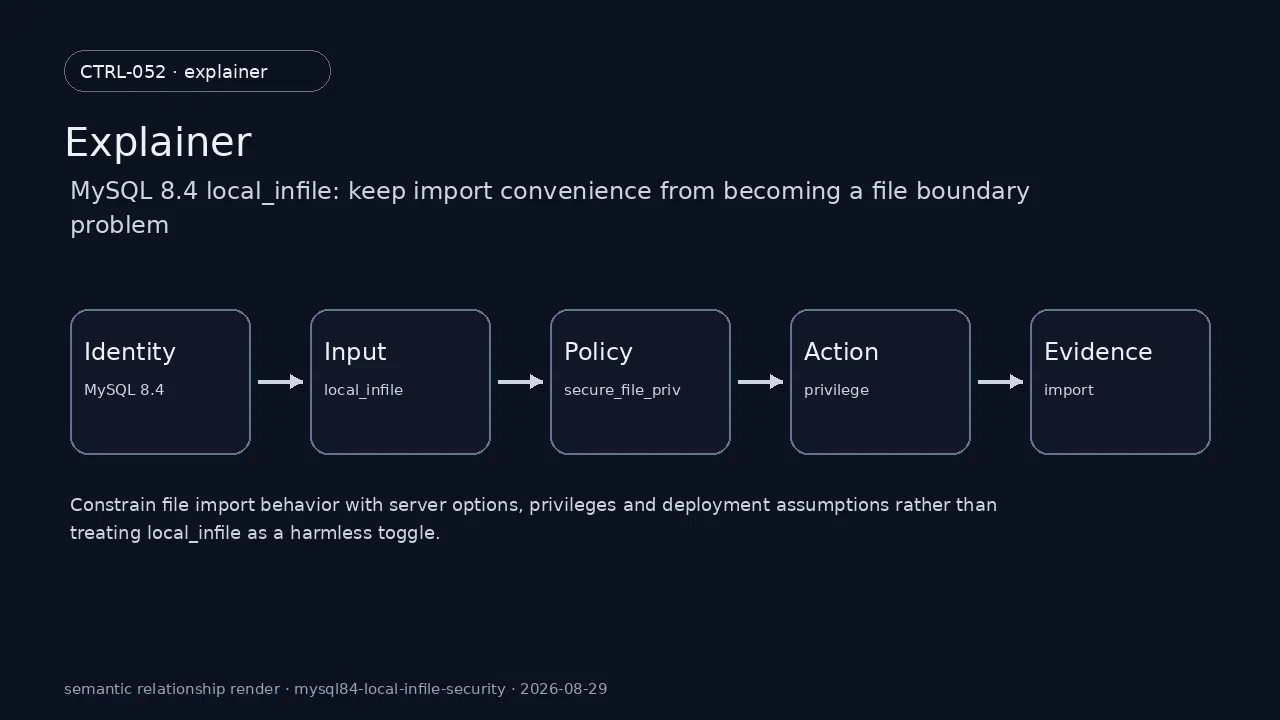
In “MySQL 8.4 local_infile: keep import convenience from becoming a file boundary problem”, scenario mysql84-local-infile-security-c71 starts at secure_file_priv and treats privilege as an explicit boundary rather than an implicit assumption. The first control requires import to emit an observable result before MySQL 8.4 can trigger the intended effect around local_infile. If the MySQL 8.4 verification fails, rollback restores the configuration around local_infile, replays mysql84-local-infile-security-c71, and compares the new state with the control evidence from secure_file_priv. This detail makes “MySQL 8.4 local_infile: keep import convenience from becoming a file boundary problem” reviewable because each operational statement points to privilege, a concrete condition, and evidence instead of a generic assurance. The conclusion stays bounded by import and local_infile: anything not demonstrated by scenario mysql84-local-infile-security-c71 is labeled as a limitation or inference, never promoted to fact.
In “MySQL 8.4 local_infile: keep import convenience from becoming a file boundary problem”, scenario mysql84-local-infile-security-c72 starts at privilege and treats import as an explicit boundary rather than an implicit assumption. The first control requires MySQL 8.4 to emit an observable result before local_infile can trigger the intended effect around secure_file_priv. That sequence serves this concrete job: Constrain file import behavior with server options, privileges and deployment assumptions rather than treating local_infile as a harmless toggle. It turns privilege into a reviewable decision point with a named input and a retained output. To test import, fixture mysql84-local-infile-security-c72 contains both an allowed state and a rejected state; rejection must occur before any change attributed to MySQL 8.4. Operations then observes the transition between MySQL 8.4 and local_infile, while security checks that secure_file_priv receives neither implicit authority nor unnecessary data.
In “MySQL 8.4 local_infile: keep import convenience from becoming a file boundary problem”, scenario mysql84-local-infile-security-c73 starts at import and treats MySQL 8.4 as an explicit boundary rather than an implicit assumption. The first control requires local_infile to emit an observable result before secure_file_priv can trigger the intended effect around privilege. If the secure_file_priv verification fails, rollback restores the configuration around privilege, replays mysql84-local-infile-security-c73, and compares the new state with the control evidence from import. This detail makes “MySQL 8.4 local_infile: keep import convenience from becoming a file boundary problem” reviewable because each operational statement points to MySQL 8.4, a concrete condition, and evidence instead of a generic assurance. The conclusion stays bounded by local_infile and privilege: anything not demonstrated by scenario mysql84-local-infile-security-c73 is labeled as a limitation or inference, never promoted to fact.
In “MySQL 8.4 local_infile: keep import convenience from becoming a file boundary problem”, scenario mysql84-local-infile-security-c74 starts at MySQL 8.4 and treats local_infile as an explicit boundary rather than an implicit assumption. The first control requires secure_file_priv to emit an observable result before privilege can trigger the intended effect around import. That sequence serves this concrete job: Constrain file import behavior with server options, privileges and deployment assumptions rather than treating local_infile as a harmless toggle. It turns MySQL 8.4 into a reviewable decision point with a named input and a retained output. To test local_infile, fixture mysql84-local-infile-security-c74 contains both an allowed state and a rejected state; rejection must occur before any change attributed to secure_file_priv. Operations then observes the transition between secure_file_priv and privilege, while security checks that import receives neither implicit authority nor unnecessary data.
Evidence point: Oracle documents that mySQL security guidance spans account privileges, application defenses, installation protection, network controls, plugins and tested recovery. This source anchors verify import with observable evidence but does not replace local verification. [S7]Controls that remain after launch
The hard part appears when the happy path meets authorization, failures, and operational constraints.
In “MySQL 8.4 local_infile: keep import convenience from becoming a file boundary problem”, scenario mysql84-local-infile-security-c81 starts at privilege and treats import as an explicit boundary rather than an implicit assumption. The first control requires MySQL 8.4 to emit an observable result before local_infile can trigger the intended effect around secure_file_priv. Operations then observes the transition between MySQL 8.4 and local_infile, while security checks that secure_file_priv receives neither implicit authority nor unnecessary data. If the local_infile verification fails, rollback restores the configuration around secure_file_priv, replays mysql84-local-infile-security-c81, and compares the new state with the control evidence from privilege. This detail makes “MySQL 8.4 local_infile: keep import convenience from becoming a file boundary problem” reviewable because each operational statement points to import, a concrete condition, and evidence instead of a generic assurance.
In “MySQL 8.4 local_infile: keep import convenience from becoming a file boundary problem”, scenario mysql84-local-infile-security-c82 starts at import and treats MySQL 8.4 as an explicit boundary rather than an implicit assumption. The first control requires local_infile to emit an observable result before secure_file_priv can trigger the intended effect around privilege. The conclusion stays bounded by local_infile and privilege: anything not demonstrated by scenario mysql84-local-infile-security-c82 is labeled as a limitation or inference, never promoted to fact. That sequence serves this concrete job: Constrain file import behavior with server options, privileges and deployment assumptions rather than treating local_infile as a harmless toggle. It turns import into a reviewable decision point with a named input and a retained output. To test MySQL 8.4, fixture mysql84-local-infile-security-c82 contains both an allowed state and a rejected state; rejection must occur before any change attributed to local_infile.
In “MySQL 8.4 local_infile: keep import convenience from becoming a file boundary problem”, scenario mysql84-local-infile-security-c83 starts at MySQL 8.4 and treats local_infile as an explicit boundary rather than an implicit assumption. The first control requires secure_file_priv to emit an observable result before privilege can trigger the intended effect around import. Operations then observes the transition between secure_file_priv and privilege, while security checks that import receives neither implicit authority nor unnecessary data. If the privilege verification fails, rollback restores the configuration around import, replays mysql84-local-infile-security-c83, and compares the new state with the control evidence from MySQL 8.4. This detail makes “MySQL 8.4 local_infile: keep import convenience from becoming a file boundary problem” reviewable because each operational statement points to local_infile, a concrete condition, and evidence instead of a generic assurance.
In “MySQL 8.4 local_infile: keep import convenience from becoming a file boundary problem”, scenario mysql84-local-infile-security-c84 starts at local_infile and treats secure_file_priv as an explicit boundary rather than an implicit assumption. The first control requires privilege to emit an observable result before import can trigger the intended effect around MySQL 8.4. The conclusion stays bounded by privilege and MySQL 8.4: anything not demonstrated by scenario mysql84-local-infile-security-c84 is labeled as a limitation or inference, never promoted to fact. That sequence serves this concrete job: Constrain file import behavior with server options, privileges and deployment assumptions rather than treating local_infile as a harmless toggle. It turns local_infile into a reviewable decision point with a named input and a retained output. To test secure_file_priv, fixture mysql84-local-infile-security-c84 contains both an allowed state and a rejected state; rejection must occur before any change attributed to privilege.
Evidence point: Oracle documents that mySQL provides pluggable security components for authentication, password validation, key storage, auditing and firewall capabilities. This source anchors controls that remain after launch but does not replace local verification. [S8]Operational checklist
- The control around MySQL 8.4 has an input, a rule, a rejection behavior, and evidence.
- The control around local_infile has an input, a rule, a rejection behavior, and evidence.
- The control around secure_file_priv has an input, a rule, a rejection behavior, and evidence.
- The control around privilege has an input, a rule, a rejection behavior, and evidence.
- The control around import has an input, a rule, a rejection behavior, and evidence.
Sources and control points
- [S1] Artificial Intelligence Risk Management Framework: Generative AI Profile — NIST AI 600-1 is a generative-AI profile for integrating trustworthiness and risk actions across the AI lifecycle. source
- [S2] AI Risk Management Framework — NIST positions the AI RMF as a voluntary framework for managing AI risks and is revising it while adding profiles for specific settings. source
- [S3] OWASP Top 10 for Large Language Model Applications — OWASP identifies its 2026 LLM Top 10 as the current release for major security risks in LLM applications. source
- [S4] OWASP Top 10 for LLM Applications 2025 — The 2025 OWASP LLM list provides the prior baseline for risks observed as LLMs became embedded in more production applications. source
- [S5] Migrating from PHP 8.3.x to PHP 8.4.x — PHP 8.4 introduces new features together with backward-incompatible and deprecated behavior that should be tested before production rollout. source
- [S6] MySQL 8.4 Security Options and Variables — MySQL exposes security-relevant server options including local_infile, secure_file_priv, skip_networking and related controls. source
- [S7] MySQL 8.4 Security — MySQL security guidance spans account privileges, application defenses, installation protection, network controls, plugins and tested recovery. source
- [S8] MySQL 8.4 Security Components and Plugins — MySQL provides pluggable security components for authentication, password validation, key storage, auditing and firewall capabilities. source
- [S9] Agents - OpenAI Agents SDK — An Agent combines instructions, tools and optional runtime behavior such as handoffs, guardrails and structured outputs. source
- [S10] Running agents - OpenAI Agents SDK — Run configuration controls model setup, guardrails, handoff behavior, tracing, tool execution and conversation state. source



Comments
No published comment yet.
Sign in to comment