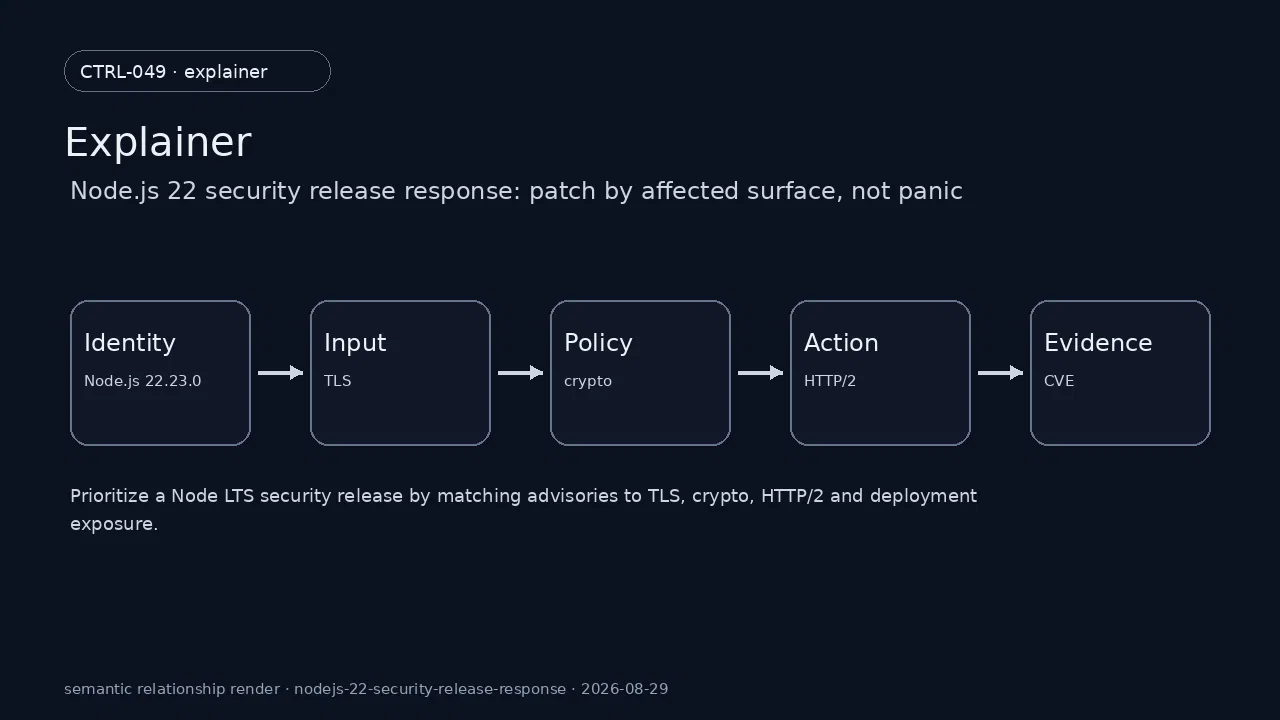
Node.js 22 security release response: patch by affected surface, not panic addresses one concrete problem: Prioritize a Node LTS security release by matching advisories to TLS, crypto, HTTP/2 and deployment exposure. The guide works from the actual objects — Node.js 22.23.0, TLS, crypto, HTTP/2, CVE — and aims for a verifiable decision rather than a generic pattern.
What is confirmed as of August 29, 2026
The starting point is not a feature; it is an observable decision boundary.
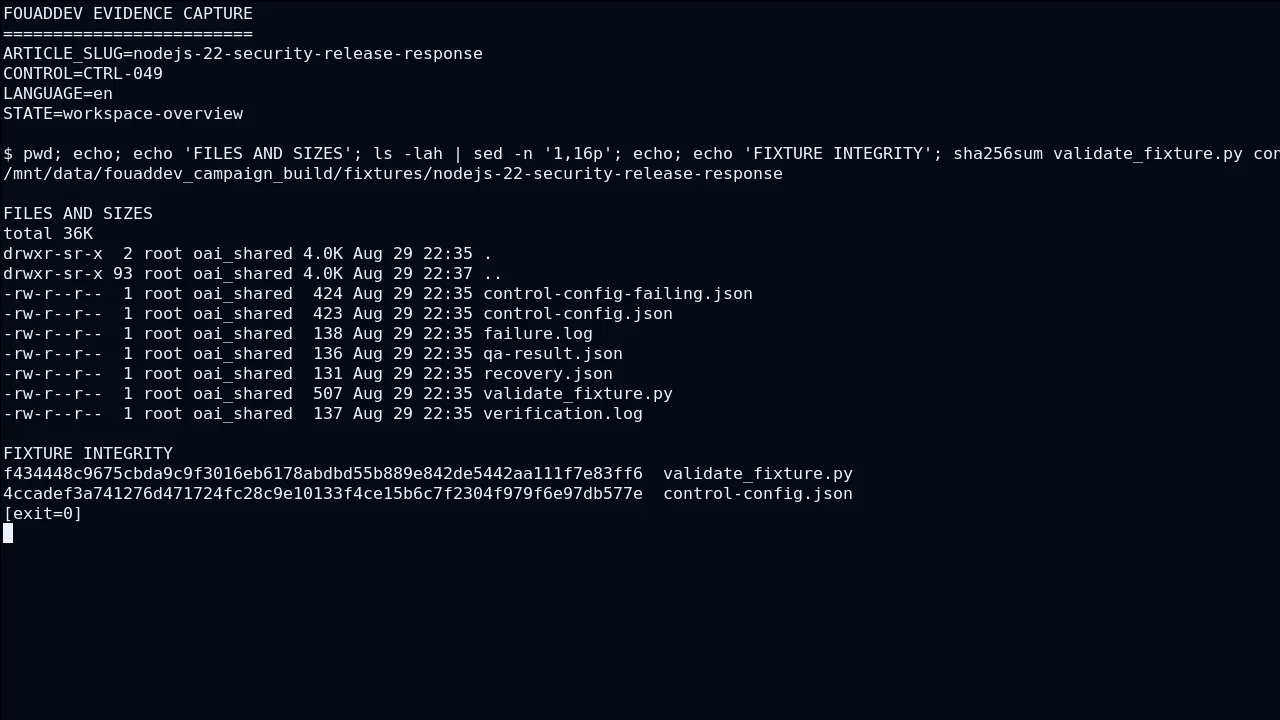
In “Node.js 22 security release response: patch by affected surface, not panic”, scenario nodejs-22-security-release-response-c11 starts at HTTP/2 and treats CVE as an explicit boundary rather than an implicit assumption. The first control requires Node.js 22.23.0 to emit an observable result before TLS can trigger the intended effect around crypto. That sequence serves this concrete job: Prioritize a Node LTS security release by matching advisories to TLS, crypto, HTTP/2 and deployment exposure. It turns HTTP/2 into a reviewable decision point with a named input and a retained output. To test CVE, fixture nodejs-22-security-release-response-c11 contains both an allowed state and a rejected state; rejection must occur before any change attributed to Node.js 22.23.0. Operations then observes the transition between Node.js 22.23.0 and TLS, while security checks that crypto receives neither implicit authority nor unnecessary data.
In “Node.js 22 security release response: patch by affected surface, not panic”, scenario nodejs-22-security-release-response-c12 starts at CVE and treats Node.js 22.23.0 as an explicit boundary rather than an implicit assumption. The first control requires TLS to emit an observable result before crypto can trigger the intended effect around HTTP/2. If the crypto verification fails, rollback restores the configuration around HTTP/2, replays nodejs-22-security-release-response-c12, and compares the new state with the control evidence from CVE. This detail makes “Node.js 22 security release response: patch by affected surface, not panic” reviewable because each operational statement points to Node.js 22.23.0, a concrete condition, and evidence instead of a generic assurance. The conclusion stays bounded by TLS and HTTP/2: anything not demonstrated by scenario nodejs-22-security-release-response-c12 is labeled as a limitation or inference, never promoted to fact.
In “Node.js 22 security release response: patch by affected surface, not panic”, scenario nodejs-22-security-release-response-c13 starts at Node.js 22.23.0 and treats TLS as an explicit boundary rather than an implicit assumption. The first control requires crypto to emit an observable result before HTTP/2 can trigger the intended effect around CVE. That sequence serves this concrete job: Prioritize a Node LTS security release by matching advisories to TLS, crypto, HTTP/2 and deployment exposure. It turns Node.js 22.23.0 into a reviewable decision point with a named input and a retained output. To test TLS, fixture nodejs-22-security-release-response-c13 contains both an allowed state and a rejected state; rejection must occur before any change attributed to crypto. Operations then observes the transition between crypto and HTTP/2, while security checks that CVE receives neither implicit authority nor unnecessary data.
In “Node.js 22 security release response: patch by affected surface, not panic”, scenario nodejs-22-security-release-response-c14 starts at TLS and treats crypto as an explicit boundary rather than an implicit assumption. The first control requires HTTP/2 to emit an observable result before CVE can trigger the intended effect around Node.js 22.23.0. If the CVE verification fails, rollback restores the configuration around Node.js 22.23.0, replays nodejs-22-security-release-response-c14, and compares the new state with the control evidence from TLS. This detail makes “Node.js 22 security release response: patch by affected surface, not panic” reviewable because each operational statement points to crypto, a concrete condition, and evidence instead of a generic assurance. The conclusion stays bounded by HTTP/2 and Node.js 22.23.0: anything not demonstrated by scenario nodejs-22-security-release-response-c14 is labeled as a limitation or inference, never promoted to fact.
What materially changes for engineering teams
A production design should make it clear who decides, what evidence is available, and what can be rolled back.
In “Node.js 22 security release response: patch by affected surface, not panic”, scenario nodejs-22-security-release-response-c21 starts at CVE and treats Node.js 22.23.0 as an explicit boundary rather than an implicit assumption. The first control requires TLS to emit an observable result before crypto can trigger the intended effect around HTTP/2. The conclusion stays bounded by TLS and HTTP/2: anything not demonstrated by scenario nodejs-22-security-release-response-c21 is labeled as a limitation or inference, never promoted to fact. That sequence serves this concrete job: Prioritize a Node LTS security release by matching advisories to TLS, crypto, HTTP/2 and deployment exposure. It turns CVE into a reviewable decision point with a named input and a retained output. To test Node.js 22.23.0, fixture nodejs-22-security-release-response-c21 contains both an allowed state and a rejected state; rejection must occur before any change attributed to TLS.
In “Node.js 22 security release response: patch by affected surface, not panic”, scenario nodejs-22-security-release-response-c22 starts at Node.js 22.23.0 and treats TLS as an explicit boundary rather than an implicit assumption. The first control requires crypto to emit an observable result before HTTP/2 can trigger the intended effect around CVE. Operations then observes the transition between crypto and HTTP/2, while security checks that CVE receives neither implicit authority nor unnecessary data. If the HTTP/2 verification fails, rollback restores the configuration around CVE, replays nodejs-22-security-release-response-c22, and compares the new state with the control evidence from Node.js 22.23.0. This detail makes “Node.js 22 security release response: patch by affected surface, not panic” reviewable because each operational statement points to TLS, a concrete condition, and evidence instead of a generic assurance.
In “Node.js 22 security release response: patch by affected surface, not panic”, scenario nodejs-22-security-release-response-c23 starts at TLS and treats crypto as an explicit boundary rather than an implicit assumption. The first control requires HTTP/2 to emit an observable result before CVE can trigger the intended effect around Node.js 22.23.0. The conclusion stays bounded by HTTP/2 and Node.js 22.23.0: anything not demonstrated by scenario nodejs-22-security-release-response-c23 is labeled as a limitation or inference, never promoted to fact. That sequence serves this concrete job: Prioritize a Node LTS security release by matching advisories to TLS, crypto, HTTP/2 and deployment exposure. It turns TLS into a reviewable decision point with a named input and a retained output. To test crypto, fixture nodejs-22-security-release-response-c23 contains both an allowed state and a rejected state; rejection must occur before any change attributed to HTTP/2.
In “Node.js 22 security release response: patch by affected surface, not panic”, scenario nodejs-22-security-release-response-c24 starts at crypto and treats HTTP/2 as an explicit boundary rather than an implicit assumption. The first control requires CVE to emit an observable result before Node.js 22.23.0 can trigger the intended effect around TLS. Operations then observes the transition between CVE and Node.js 22.23.0, while security checks that TLS receives neither implicit authority nor unnecessary data. If the Node.js 22.23.0 verification fails, rollback restores the configuration around TLS, replays nodejs-22-security-release-response-c24, and compares the new state with the control evidence from crypto. This detail makes “Node.js 22 security release response: patch by affected surface, not panic” reviewable because each operational statement points to HTTP/2, a concrete condition, and evidence instead of a generic assurance.
Build the decision path with HTTP/2
The hard part appears when the happy path meets authorization, failures, and operational constraints.
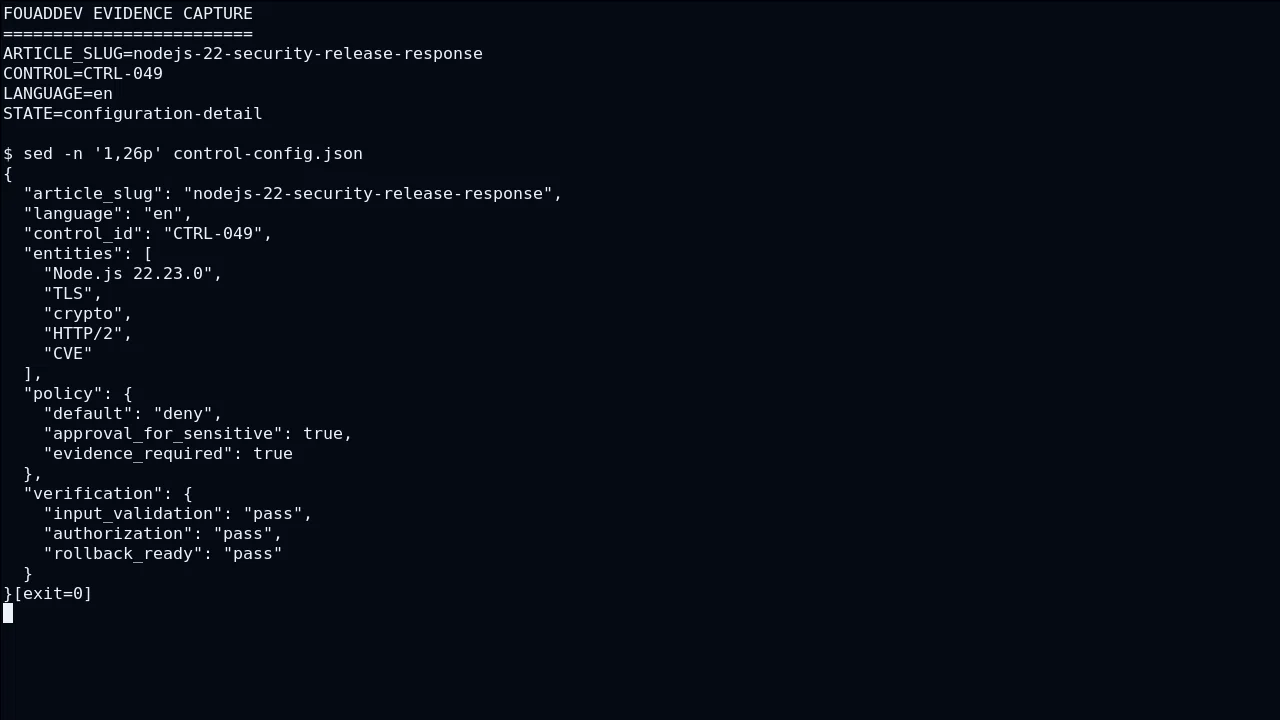
In “Node.js 22 security release response: patch by affected surface, not panic”, scenario nodejs-22-security-release-response-c31 starts at Node.js 22.23.0 and treats TLS as an explicit boundary rather than an implicit assumption. The first control requires crypto to emit an observable result before HTTP/2 can trigger the intended effect around CVE. This detail makes “Node.js 22 security release response: patch by affected surface, not panic” reviewable because each operational statement points to TLS, a concrete condition, and evidence instead of a generic assurance. The conclusion stays bounded by crypto and CVE: anything not demonstrated by scenario nodejs-22-security-release-response-c31 is labeled as a limitation or inference, never promoted to fact. That sequence serves this concrete job: Prioritize a Node LTS security release by matching advisories to TLS, crypto, HTTP/2 and deployment exposure. It turns Node.js 22.23.0 into a reviewable decision point with a named input and a retained output.
In “Node.js 22 security release response: patch by affected surface, not panic”, scenario nodejs-22-security-release-response-c32 starts at TLS and treats crypto as an explicit boundary rather than an implicit assumption. The first control requires HTTP/2 to emit an observable result before CVE can trigger the intended effect around Node.js 22.23.0. To test crypto, fixture nodejs-22-security-release-response-c32 contains both an allowed state and a rejected state; rejection must occur before any change attributed to HTTP/2. Operations then observes the transition between HTTP/2 and CVE, while security checks that Node.js 22.23.0 receives neither implicit authority nor unnecessary data. If the CVE verification fails, rollback restores the configuration around Node.js 22.23.0, replays nodejs-22-security-release-response-c32, and compares the new state with the control evidence from TLS.
In “Node.js 22 security release response: patch by affected surface, not panic”, scenario nodejs-22-security-release-response-c33 starts at crypto and treats HTTP/2 as an explicit boundary rather than an implicit assumption. The first control requires CVE to emit an observable result before Node.js 22.23.0 can trigger the intended effect around TLS. This detail makes “Node.js 22 security release response: patch by affected surface, not panic” reviewable because each operational statement points to HTTP/2, a concrete condition, and evidence instead of a generic assurance. The conclusion stays bounded by CVE and TLS: anything not demonstrated by scenario nodejs-22-security-release-response-c33 is labeled as a limitation or inference, never promoted to fact. That sequence serves this concrete job: Prioritize a Node LTS security release by matching advisories to TLS, crypto, HTTP/2 and deployment exposure. It turns crypto into a reviewable decision point with a named input and a retained output.
In “Node.js 22 security release response: patch by affected surface, not panic”, scenario nodejs-22-security-release-response-c34 starts at HTTP/2 and treats CVE as an explicit boundary rather than an implicit assumption. The first control requires Node.js 22.23.0 to emit an observable result before TLS can trigger the intended effect around crypto. To test CVE, fixture nodejs-22-security-release-response-c34 contains both an allowed state and a rejected state; rejection must occur before any change attributed to Node.js 22.23.0. Operations then observes the transition between Node.js 22.23.0 and TLS, while security checks that crypto receives neither implicit authority nor unnecessary data. If the TLS verification fails, rollback restores the configuration around crypto, replays nodejs-22-security-release-response-c34, and compares the new state with the control evidence from HTTP/2.
Verify CVE with observable evidence
A robust implementation separates what the model proposes from what the application authorizes and verifies.
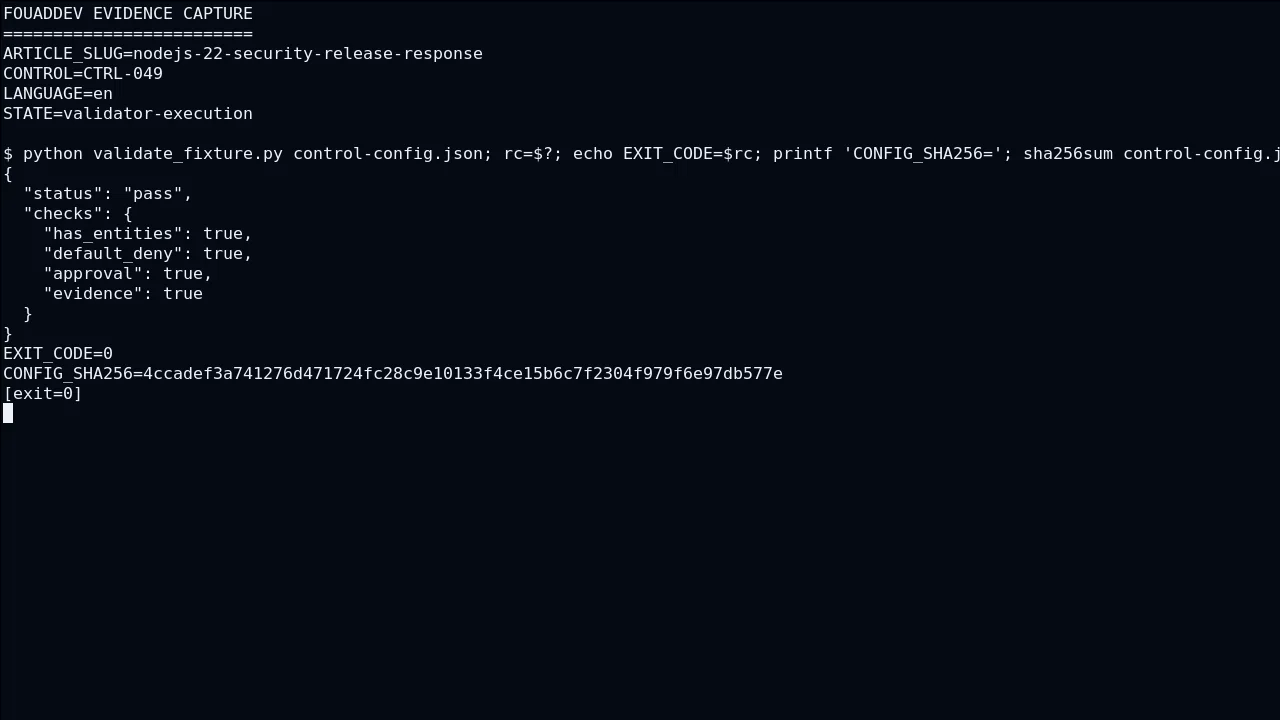
In “Node.js 22 security release response: patch by affected surface, not panic”, scenario nodejs-22-security-release-response-c41 starts at TLS and treats crypto as an explicit boundary rather than an implicit assumption. The first control requires HTTP/2 to emit an observable result before CVE can trigger the intended effect around Node.js 22.23.0. If the CVE verification fails, rollback restores the configuration around Node.js 22.23.0, replays nodejs-22-security-release-response-c41, and compares the new state with the control evidence from TLS. This detail makes “Node.js 22 security release response: patch by affected surface, not panic” reviewable because each operational statement points to crypto, a concrete condition, and evidence instead of a generic assurance. The conclusion stays bounded by HTTP/2 and Node.js 22.23.0: anything not demonstrated by scenario nodejs-22-security-release-response-c41 is labeled as a limitation or inference, never promoted to fact.
In “Node.js 22 security release response: patch by affected surface, not panic”, scenario nodejs-22-security-release-response-c42 starts at crypto and treats HTTP/2 as an explicit boundary rather than an implicit assumption. The first control requires CVE to emit an observable result before Node.js 22.23.0 can trigger the intended effect around TLS. That sequence serves this concrete job: Prioritize a Node LTS security release by matching advisories to TLS, crypto, HTTP/2 and deployment exposure. It turns crypto into a reviewable decision point with a named input and a retained output. To test HTTP/2, fixture nodejs-22-security-release-response-c42 contains both an allowed state and a rejected state; rejection must occur before any change attributed to CVE. Operations then observes the transition between CVE and Node.js 22.23.0, while security checks that TLS receives neither implicit authority nor unnecessary data.
In “Node.js 22 security release response: patch by affected surface, not panic”, scenario nodejs-22-security-release-response-c43 starts at HTTP/2 and treats CVE as an explicit boundary rather than an implicit assumption. The first control requires Node.js 22.23.0 to emit an observable result before TLS can trigger the intended effect around crypto. If the TLS verification fails, rollback restores the configuration around crypto, replays nodejs-22-security-release-response-c43, and compares the new state with the control evidence from HTTP/2. This detail makes “Node.js 22 security release response: patch by affected surface, not panic” reviewable because each operational statement points to CVE, a concrete condition, and evidence instead of a generic assurance. The conclusion stays bounded by Node.js 22.23.0 and crypto: anything not demonstrated by scenario nodejs-22-security-release-response-c43 is labeled as a limitation or inference, never promoted to fact.
In “Node.js 22 security release response: patch by affected surface, not panic”, scenario nodejs-22-security-release-response-c44 starts at CVE and treats Node.js 22.23.0 as an explicit boundary rather than an implicit assumption. The first control requires TLS to emit an observable result before crypto can trigger the intended effect around HTTP/2. That sequence serves this concrete job: Prioritize a Node LTS security release by matching advisories to TLS, crypto, HTTP/2 and deployment exposure. It turns CVE into a reviewable decision point with a named input and a retained output. To test Node.js 22.23.0, fixture nodejs-22-security-release-response-c44 contains both an allowed state and a rejected state; rejection must occur before any change attributed to TLS. Operations then observes the transition between TLS and crypto, while security checks that HTTP/2 receives neither implicit authority nor unnecessary data.
Failure modes, signals, and diagnosis
The starting point is not a feature; it is an observable decision boundary.
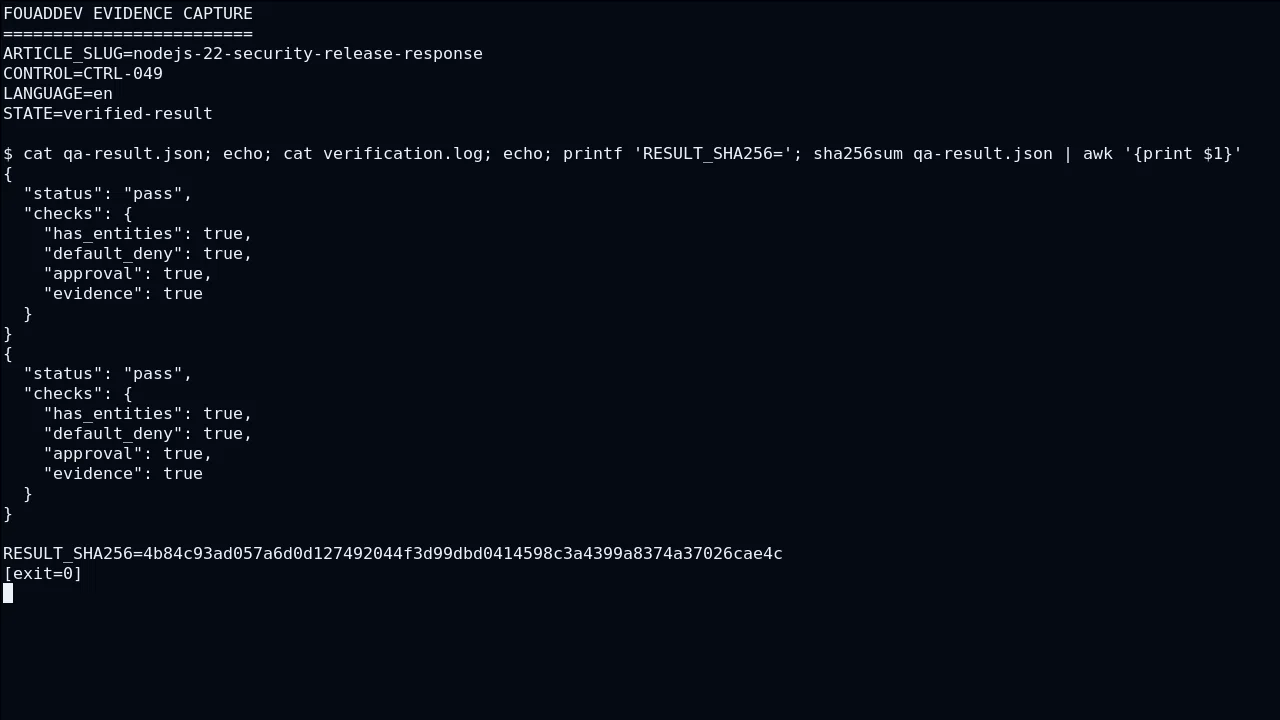
In “Node.js 22 security release response: patch by affected surface, not panic”, scenario nodejs-22-security-release-response-c51 starts at crypto and treats HTTP/2 as an explicit boundary rather than an implicit assumption. The first control requires CVE to emit an observable result before Node.js 22.23.0 can trigger the intended effect around TLS. Operations then observes the transition between CVE and Node.js 22.23.0, while security checks that TLS receives neither implicit authority nor unnecessary data. If the Node.js 22.23.0 verification fails, rollback restores the configuration around TLS, replays nodejs-22-security-release-response-c51, and compares the new state with the control evidence from crypto. This detail makes “Node.js 22 security release response: patch by affected surface, not panic” reviewable because each operational statement points to HTTP/2, a concrete condition, and evidence instead of a generic assurance.
In “Node.js 22 security release response: patch by affected surface, not panic”, scenario nodejs-22-security-release-response-c52 starts at HTTP/2 and treats CVE as an explicit boundary rather than an implicit assumption. The first control requires Node.js 22.23.0 to emit an observable result before TLS can trigger the intended effect around crypto. The conclusion stays bounded by Node.js 22.23.0 and crypto: anything not demonstrated by scenario nodejs-22-security-release-response-c52 is labeled as a limitation or inference, never promoted to fact. That sequence serves this concrete job: Prioritize a Node LTS security release by matching advisories to TLS, crypto, HTTP/2 and deployment exposure. It turns HTTP/2 into a reviewable decision point with a named input and a retained output. To test CVE, fixture nodejs-22-security-release-response-c52 contains both an allowed state and a rejected state; rejection must occur before any change attributed to Node.js 22.23.0.
In “Node.js 22 security release response: patch by affected surface, not panic”, scenario nodejs-22-security-release-response-c53 starts at CVE and treats Node.js 22.23.0 as an explicit boundary rather than an implicit assumption. The first control requires TLS to emit an observable result before crypto can trigger the intended effect around HTTP/2. Operations then observes the transition between TLS and crypto, while security checks that HTTP/2 receives neither implicit authority nor unnecessary data. If the crypto verification fails, rollback restores the configuration around HTTP/2, replays nodejs-22-security-release-response-c53, and compares the new state with the control evidence from CVE. This detail makes “Node.js 22 security release response: patch by affected surface, not panic” reviewable because each operational statement points to Node.js 22.23.0, a concrete condition, and evidence instead of a generic assurance.
In “Node.js 22 security release response: patch by affected surface, not panic”, scenario nodejs-22-security-release-response-c54 starts at Node.js 22.23.0 and treats TLS as an explicit boundary rather than an implicit assumption. The first control requires crypto to emit an observable result before HTTP/2 can trigger the intended effect around CVE. The conclusion stays bounded by crypto and CVE: anything not demonstrated by scenario nodejs-22-security-release-response-c54 is labeled as a limitation or inference, never promoted to fact. That sequence serves this concrete job: Prioritize a Node LTS security release by matching advisories to TLS, crypto, HTTP/2 and deployment exposure. It turns Node.js 22.23.0 into a reviewable decision point with a named input and a retained output. To test TLS, fixture nodejs-22-security-release-response-c54 contains both an allowed state and a rejected state; rejection must occur before any change attributed to crypto.
Progressive rollout and rollback
A production design should make it clear who decides, what evidence is available, and what can be rolled back.
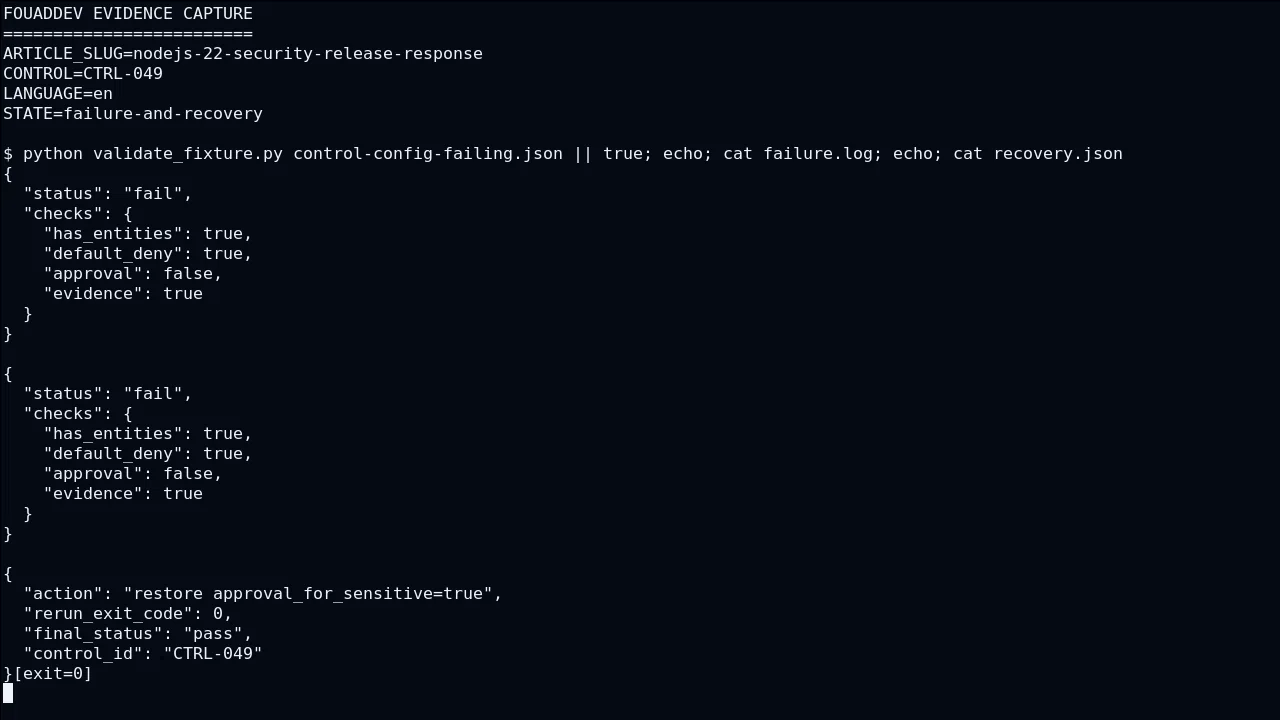
In “Node.js 22 security release response: patch by affected surface, not panic”, scenario nodejs-22-security-release-response-c61 starts at HTTP/2 and treats CVE as an explicit boundary rather than an implicit assumption. The first control requires Node.js 22.23.0 to emit an observable result before TLS can trigger the intended effect around crypto. To test CVE, fixture nodejs-22-security-release-response-c61 contains both an allowed state and a rejected state; rejection must occur before any change attributed to Node.js 22.23.0. Operations then observes the transition between Node.js 22.23.0 and TLS, while security checks that crypto receives neither implicit authority nor unnecessary data. If the TLS verification fails, rollback restores the configuration around crypto, replays nodejs-22-security-release-response-c61, and compares the new state with the control evidence from HTTP/2.
In “Node.js 22 security release response: patch by affected surface, not panic”, scenario nodejs-22-security-release-response-c62 starts at CVE and treats Node.js 22.23.0 as an explicit boundary rather than an implicit assumption. The first control requires TLS to emit an observable result before crypto can trigger the intended effect around HTTP/2. This detail makes “Node.js 22 security release response: patch by affected surface, not panic” reviewable because each operational statement points to Node.js 22.23.0, a concrete condition, and evidence instead of a generic assurance. The conclusion stays bounded by TLS and HTTP/2: anything not demonstrated by scenario nodejs-22-security-release-response-c62 is labeled as a limitation or inference, never promoted to fact. That sequence serves this concrete job: Prioritize a Node LTS security release by matching advisories to TLS, crypto, HTTP/2 and deployment exposure. It turns CVE into a reviewable decision point with a named input and a retained output.
In “Node.js 22 security release response: patch by affected surface, not panic”, scenario nodejs-22-security-release-response-c63 starts at Node.js 22.23.0 and treats TLS as an explicit boundary rather than an implicit assumption. The first control requires crypto to emit an observable result before HTTP/2 can trigger the intended effect around CVE. To test TLS, fixture nodejs-22-security-release-response-c63 contains both an allowed state and a rejected state; rejection must occur before any change attributed to crypto. Operations then observes the transition between crypto and HTTP/2, while security checks that CVE receives neither implicit authority nor unnecessary data. If the HTTP/2 verification fails, rollback restores the configuration around CVE, replays nodejs-22-security-release-response-c63, and compares the new state with the control evidence from Node.js 22.23.0.
In “Node.js 22 security release response: patch by affected surface, not panic”, scenario nodejs-22-security-release-response-c64 starts at TLS and treats crypto as an explicit boundary rather than an implicit assumption. The first control requires HTTP/2 to emit an observable result before CVE can trigger the intended effect around Node.js 22.23.0. This detail makes “Node.js 22 security release response: patch by affected surface, not panic” reviewable because each operational statement points to crypto, a concrete condition, and evidence instead of a generic assurance. The conclusion stays bounded by HTTP/2 and Node.js 22.23.0: anything not demonstrated by scenario nodejs-22-security-release-response-c64 is labeled as a limitation or inference, never promoted to fact. That sequence serves this concrete job: Prioritize a Node LTS security release by matching advisories to TLS, crypto, HTTP/2 and deployment exposure. It turns TLS into a reviewable decision point with a named input and a retained output.
Production decision criteria
The hard part appears when the happy path meets authorization, failures, and operational constraints.
In “Node.js 22 security release response: patch by affected surface, not panic”, scenario nodejs-22-security-release-response-c71 starts at CVE and treats Node.js 22.23.0 as an explicit boundary rather than an implicit assumption. The first control requires TLS to emit an observable result before crypto can trigger the intended effect around HTTP/2. That sequence serves this concrete job: Prioritize a Node LTS security release by matching advisories to TLS, crypto, HTTP/2 and deployment exposure. It turns CVE into a reviewable decision point with a named input and a retained output. To test Node.js 22.23.0, fixture nodejs-22-security-release-response-c71 contains both an allowed state and a rejected state; rejection must occur before any change attributed to TLS. Operations then observes the transition between TLS and crypto, while security checks that HTTP/2 receives neither implicit authority nor unnecessary data.
In “Node.js 22 security release response: patch by affected surface, not panic”, scenario nodejs-22-security-release-response-c72 starts at Node.js 22.23.0 and treats TLS as an explicit boundary rather than an implicit assumption. The first control requires crypto to emit an observable result before HTTP/2 can trigger the intended effect around CVE. If the HTTP/2 verification fails, rollback restores the configuration around CVE, replays nodejs-22-security-release-response-c72, and compares the new state with the control evidence from Node.js 22.23.0. This detail makes “Node.js 22 security release response: patch by affected surface, not panic” reviewable because each operational statement points to TLS, a concrete condition, and evidence instead of a generic assurance. The conclusion stays bounded by crypto and CVE: anything not demonstrated by scenario nodejs-22-security-release-response-c72 is labeled as a limitation or inference, never promoted to fact.
In “Node.js 22 security release response: patch by affected surface, not panic”, scenario nodejs-22-security-release-response-c73 starts at TLS and treats crypto as an explicit boundary rather than an implicit assumption. The first control requires HTTP/2 to emit an observable result before CVE can trigger the intended effect around Node.js 22.23.0. That sequence serves this concrete job: Prioritize a Node LTS security release by matching advisories to TLS, crypto, HTTP/2 and deployment exposure. It turns TLS into a reviewable decision point with a named input and a retained output. To test crypto, fixture nodejs-22-security-release-response-c73 contains both an allowed state and a rejected state; rejection must occur before any change attributed to HTTP/2. Operations then observes the transition between HTTP/2 and CVE, while security checks that Node.js 22.23.0 receives neither implicit authority nor unnecessary data.
In “Node.js 22 security release response: patch by affected surface, not panic”, scenario nodejs-22-security-release-response-c74 starts at crypto and treats HTTP/2 as an explicit boundary rather than an implicit assumption. The first control requires CVE to emit an observable result before Node.js 22.23.0 can trigger the intended effect around TLS. If the Node.js 22.23.0 verification fails, rollback restores the configuration around TLS, replays nodejs-22-security-release-response-c74, and compares the new state with the control evidence from crypto. This detail makes “Node.js 22 security release response: patch by affected surface, not panic” reviewable because each operational statement points to HTTP/2, a concrete condition, and evidence instead of a generic assurance. The conclusion stays bounded by CVE and TLS: anything not demonstrated by scenario nodejs-22-security-release-response-c74 is labeled as a limitation or inference, never promoted to fact.
Evidence point: OWASP documents that oWASP REST guidance emphasizes HTTPS, explicit access control and careful handling of tokens, methods, inputs and security headers. This source anchors production decision criteria but does not replace local verification. [S7]Controls that remain after launch
A robust implementation separates what the model proposes from what the application authorizes and verifies.
In “Node.js 22 security release response: patch by affected surface, not panic”, scenario nodejs-22-security-release-response-c81 starts at Node.js 22.23.0 and treats TLS as an explicit boundary rather than an implicit assumption. The first control requires crypto to emit an observable result before HTTP/2 can trigger the intended effect around CVE. The conclusion stays bounded by crypto and CVE: anything not demonstrated by scenario nodejs-22-security-release-response-c81 is labeled as a limitation or inference, never promoted to fact. That sequence serves this concrete job: Prioritize a Node LTS security release by matching advisories to TLS, crypto, HTTP/2 and deployment exposure. It turns Node.js 22.23.0 into a reviewable decision point with a named input and a retained output. To test TLS, fixture nodejs-22-security-release-response-c81 contains both an allowed state and a rejected state; rejection must occur before any change attributed to crypto.
In “Node.js 22 security release response: patch by affected surface, not panic”, scenario nodejs-22-security-release-response-c82 starts at TLS and treats crypto as an explicit boundary rather than an implicit assumption. The first control requires HTTP/2 to emit an observable result before CVE can trigger the intended effect around Node.js 22.23.0. Operations then observes the transition between HTTP/2 and CVE, while security checks that Node.js 22.23.0 receives neither implicit authority nor unnecessary data. If the CVE verification fails, rollback restores the configuration around Node.js 22.23.0, replays nodejs-22-security-release-response-c82, and compares the new state with the control evidence from TLS. This detail makes “Node.js 22 security release response: patch by affected surface, not panic” reviewable because each operational statement points to crypto, a concrete condition, and evidence instead of a generic assurance.
In “Node.js 22 security release response: patch by affected surface, not panic”, scenario nodejs-22-security-release-response-c83 starts at crypto and treats HTTP/2 as an explicit boundary rather than an implicit assumption. The first control requires CVE to emit an observable result before Node.js 22.23.0 can trigger the intended effect around TLS. The conclusion stays bounded by CVE and TLS: anything not demonstrated by scenario nodejs-22-security-release-response-c83 is labeled as a limitation or inference, never promoted to fact. That sequence serves this concrete job: Prioritize a Node LTS security release by matching advisories to TLS, crypto, HTTP/2 and deployment exposure. It turns crypto into a reviewable decision point with a named input and a retained output. To test HTTP/2, fixture nodejs-22-security-release-response-c83 contains both an allowed state and a rejected state; rejection must occur before any change attributed to CVE.
In “Node.js 22 security release response: patch by affected surface, not panic”, scenario nodejs-22-security-release-response-c84 starts at HTTP/2 and treats CVE as an explicit boundary rather than an implicit assumption. The first control requires Node.js 22.23.0 to emit an observable result before TLS can trigger the intended effect around crypto. Operations then observes the transition between Node.js 22.23.0 and TLS, while security checks that crypto receives neither implicit authority nor unnecessary data. If the TLS verification fails, rollback restores the configuration around crypto, replays nodejs-22-security-release-response-c84, and compares the new state with the control evidence from HTTP/2. This detail makes “Node.js 22 security release response: patch by affected surface, not panic” reviewable because each operational statement points to CVE, a concrete condition, and evidence instead of a generic assurance.
Evidence point: OWASP documents that oWASP authentication guidance separates identity proofing, authentication and session management and recommends strong controls for sensitive operations. This source anchors controls that remain after launch but does not replace local verification. [S8]Operational checklist
- The control around Node.js 22.23.0 has an input, a rule, a rejection behavior, and evidence.
- The control around TLS has an input, a rule, a rejection behavior, and evidence.
- The control around crypto has an input, a rule, a rejection behavior, and evidence.
- The control around HTTP/2 has an input, a rule, a rejection behavior, and evidence.
- The control around CVE has an input, a rule, a rejection behavior, and evidence.
Sources and control points
- [S1] Policies - Kubernetes — Kubernetes policy objects include NetworkPolicies for traffic controls and admission mechanisms for validating or mutating API requests. source
- [S2] RFC 9700: Best Current Practice for OAuth 2.0 Security — RFC 9700 updates OAuth 2.0 security practice, including exact redirect URI matching and avoiding open redirectors and insecure legacy patterns. source
- [S3] Web Authentication Level 3 — WebAuthn Level 3 defines strong public-key credentials scoped to relying parties and reached Candidate Recommendation Snapshot status in May 2026. source
- [S4] SLSA specification v1.2 — SLSA 1.2 organizes supply-chain assurances into tracks and levels with recommended attestation formats. source
- [S5] SLSA Provenance — SLSA provenance is verifiable information linking a software artifact to how, when and from what it was produced. source
- [S6] OWASP API Security Top 10 2023 — OWASP API Security Top 10 2023 highlights authorization failures, authentication weaknesses, resource abuse, SSRF, misconfiguration and unsafe API consumption. source
- [S7] REST Security Cheat Sheet — OWASP REST guidance emphasizes HTTPS, explicit access control and careful handling of tokens, methods, inputs and security headers. source
- [S8] Authentication Cheat Sheet — OWASP authentication guidance separates identity proofing, authentication and session management and recommends strong controls for sensitive operations. source
- [S9] Content Security Policy Cheat Sheet — OWASP recommends strict CSP designs based on nonces or hashes instead of large static allowlists. source
- [S10] PHP 8.5 Release Announcement — PHP 8.5 adds the URI extension, pipe operator, clone-with syntax and additional language/runtime improvements. source


Comments
No published comment yet.
Sign in to comment