The disaster exposed a tourism risk model that must handle missing-person accounting, route isolation, multilingual warnings, operator duty of care and consular data under fast-changing mountain hazards.
Factual update point: 30 August 2026. Casualty and rescue figures were still evolving; time-sensitive numbers must be read with their date and source.
Reader question: Turn the 2026 disaster into practical operating rules for tourism businesses, guides, travelers and consular responders. Promised outcome: Reduce the time needed to account for people, warn groups, reroute trips and support families during a transboundary mountain emergency.
Traveler accounting is safety infrastructure
Tourism systems optimize bookings and permits, but a traveler can change lodge, route, guide or vehicle without every database updating. In the context of “Traveler accounting is safety infrastructure”, the point matters only when it changes an operating decision. To turn the 2026 disaster into practical operating rules for tourism businesses, guides, travelers and consular responders., a team should identify the observable signal, who receives it, how quickly action must follow and what evidence will show that the control actually worked. A procedure that cannot be exercised under degraded access, power or communications should not be treated as proven readiness. The practical outcome remains: Reduce the time needed to account for people, warn groups, reroute trips and support families during a transboundary mountain emergency.
After the flood, governments published changing counts of missing, uncontactable and stranded nationals; those were operational snapshots, not final casualty lists. This is a control problem as much as a descriptive one. For “Traveler accounting is safety infrastructure”, keep the source, date, uncertainty and mechanism that connects the observation to service loss or human exposure. Then test the decision against a plausible failure of another dependency. This prevents a plan from working only in the ideal conditions that disappear during a mountain disaster. The reader job is to turn the 2026 disaster into practical operating rules for tourism businesses, guides, travelers and consular responders., and the result should be measurable against this outcome: Reduce the time needed to account for people, warn groups, reroute trips and support families during a transboundary mountain emergency.
A minimal last-known-safe checkpoint and scheduled check-in gives responders a search area without requiring permanent surveillance. The operational implication is to connect evidence, trigger and ownership instead of adding another generic checklist. In “Traveler accounting is safety infrastructure”, every important assumption should be visible, every threshold should have a rationale, and every failed exercise should create a specific corrective action. The review should also ask who becomes least protected when access or communications fail. That discipline supports the task to turn the 2026 disaster into practical operating rules for tourism businesses, guides, travelers and consular responders. and leads toward the intended outcome: Reduce the time needed to account for people, warn groups, reroute trips and support families during a transboundary mountain emergency.
Opened and read evidence: S1 · Reuters · S4 · Reuters · S8 · UNDRR
Warn people who do not know local geography
A resident may understand a landmark-based evacuation instruction that is meaningless to a first-time visitor. A defensible decision then asks three questions: what is known, what could still change, and which action remains safe if the uncertainty resolves badly? “Warn people who do not know local geography” should be revisited after material new evidence or terrain change. During the emergency, reversible precautions are often preferable; irreversible reconstruction or investment choices deserve a stronger evidence threshold. That approach serves the reader need to turn the 2026 disaster into practical operating rules for tourism businesses, guides, travelers and consular responders. and aims to reduce the time needed to account for people, warn groups, reroute trips and support families during a transboundary mountain emergency.
Tourist corridors need simple multilingual cues, recognizable evacuation symbols and pre-identified safe assembly points. In the context of “Warn people who do not know local geography”, the point matters only when it changes an operating decision. To turn the 2026 disaster into practical operating rules for tourism businesses, guides, travelers and consular responders., a team should identify the observable signal, who receives it, how quickly action must follow and what evidence will show that the control actually worked. A procedure that cannot be exercised under degraded access, power or communications should not be treated as proven readiness. The practical outcome remains: Reduce the time needed to account for people, warn groups, reroute trips and support families during a transboundary mountain emergency.
Groups should receive the briefing before entering a narrow valley, not while reading a long alert during the emergency. This is a control problem as much as a descriptive one. For “Warn people who do not know local geography”, keep the source, date, uncertainty and mechanism that connects the observation to service loss or human exposure. Then test the decision against a plausible failure of another dependency. This prevents a plan from working only in the ideal conditions that disappear during a mountain disaster. The reader job is to turn the 2026 disaster into practical operating rules for tourism businesses, guides, travelers and consular responders., and the result should be measurable against this outcome: Reduce the time needed to account for people, warn groups, reroute trips and support families during a transboundary mountain emergency.
Opened and read evidence: S2 · Reuters · S5 · Reuters · S9 · World Health Organization
Manage cascading hazards, not a single closure
Barrier lakes, new landslides and rainfall can change route safety after the first flood has passed. The operational implication is to connect evidence, trigger and ownership instead of adding another generic checklist. In “Manage cascading hazards, not a single closure”, every important assumption should be visible, every threshold should have a rationale, and every failed exercise should create a specific corrective action. The review should also ask who becomes least protected when access or communications fail. That discipline supports the task to turn the 2026 disaster into practical operating rules for tourism businesses, guides, travelers and consular responders. and leads toward the intended outcome: Reduce the time needed to account for people, warn groups, reroute trips and support families during a transboundary mountain emergency.
A route should therefore be authorized with a timestamp, conditions and a defined trigger for closure rather than labeled simply open or closed. A defensible decision then asks three questions: what is known, what could still change, and which action remains safe if the uncertainty resolves badly? “Manage cascading hazards, not a single closure” should be revisited after material new evidence or terrain change. During the emergency, reversible precautions are often preferable; irreversible reconstruction or investment choices deserve a stronger evidence threshold. That approach serves the reader need to turn the 2026 disaster into practical operating rules for tourism businesses, guides, travelers and consular responders. and aims to reduce the time needed to account for people, warn groups, reroute trips and support families during a transboundary mountain emergency.
Commercial pressure to preserve an itinerary must be separated from the guide's safety decision. In the context of “Manage cascading hazards, not a single closure”, the point matters only when it changes an operating decision. To turn the 2026 disaster into practical operating rules for tourism businesses, guides, travelers and consular responders., a team should identify the observable signal, who receives it, how quickly action must follow and what evidence will show that the control actually worked. A procedure that cannot be exercised under degraded access, power or communications should not be treated as proven readiness. The practical outcome remains: Reduce the time needed to account for people, warn groups, reroute trips and support families during a transboundary mountain emergency.
Opened and read evidence: S3 · Reuters · S6 · Reuters · S10 · UNICEF Nepal
Give guides authority and a protocol
A guide who must call headquarters for every route change loses time when communications fail. This is a control problem as much as a descriptive one. For “Give guides authority and a protocol”, keep the source, date, uncertainty and mechanism that connects the observation to service loss or human exposure. Then test the decision against a plausible failure of another dependency. This prevents a plan from working only in the ideal conditions that disappear during a mountain disaster. The reader job is to turn the 2026 disaster into practical operating rules for tourism businesses, guides, travelers and consular responders., and the result should be measurable against this outcome: Reduce the time needed to account for people, warn groups, reroute trips and support families during a transboundary mountain emergency.
Companies should delegate authority to move to high ground, abandon equipment, cancel a stage and use an alternate assembly point under predefined conditions. The operational implication is to connect evidence, trigger and ownership instead of adding another generic checklist. In “Give guides authority and a protocol”, every important assumption should be visible, every threshold should have a rationale, and every failed exercise should create a specific corrective action. The review should also ask who becomes least protected when access or communications fail. That discipline supports the task to turn the 2026 disaster into practical operating rules for tourism businesses, guides, travelers and consular responders. and leads toward the intended outcome: Reduce the time needed to account for people, warn groups, reroute trips and support families during a transboundary mountain emergency.
Field teams need basic first aid, offline maps, group accounting and an appropriate independent communication option. A defensible decision then asks three questions: what is known, what could still change, and which action remains safe if the uncertainty resolves badly? “Give guides authority and a protocol” should be revisited after material new evidence or terrain change. During the emergency, reversible precautions are often preferable; irreversible reconstruction or investment choices deserve a stronger evidence threshold. That approach serves the reader need to turn the 2026 disaster into practical operating rules for tourism businesses, guides, travelers and consular responders. and aims to reduce the time needed to account for people, warn groups, reroute trips and support families during a transboundary mountain emergency.
Opened and read evidence: S4 · Reuters · S7 · IFRC · S11 · World Bank
Use clean status definitions for consular response
Missing, uncontactable, stranded, evacuated and confirmed-safe are different states with different search and support actions. In the context of “Use clean status definitions for consular response”, the point matters only when it changes an operating decision. To turn the 2026 disaster into practical operating rules for tourism businesses, guides, travelers and consular responders., a team should identify the observable signal, who receives it, how quickly action must follow and what evidence will show that the control actually worked. A procedure that cannot be exercised under degraded access, power or communications should not be treated as proven readiness. The practical outcome remains: Reduce the time needed to account for people, warn groups, reroute trips and support families during a transboundary mountain emergency.
Tour operators can provide identity, itinerary and last verified checkpoint through secure channels without widely circulating passport copies. This is a control problem as much as a descriptive one. For “Use clean status definitions for consular response”, keep the source, date, uncertainty and mechanism that connects the observation to service loss or human exposure. Then test the decision against a plausible failure of another dependency. This prevents a plan from working only in the ideal conditions that disappear during a mountain disaster. The reader job is to turn the 2026 disaster into practical operating rules for tourism businesses, guides, travelers and consular responders., and the result should be measurable against this outcome: Reduce the time needed to account for people, warn groups, reroute trips and support families during a transboundary mountain emergency.
Each status needs a timestamp because a person can move from uncontactable to safe as communications return. The operational implication is to connect evidence, trigger and ownership instead of adding another generic checklist. In “Use clean status definitions for consular response”, every important assumption should be visible, every threshold should have a rationale, and every failed exercise should create a specific corrective action. The review should also ask who becomes least protected when access or communications fail. That discipline supports the task to turn the 2026 disaster into practical operating rules for tourism businesses, guides, travelers and consular responders. and leads toward the intended outcome: Reduce the time needed to account for people, warn groups, reroute trips and support families during a transboundary mountain emergency.
Opened and read evidence: S5 · Reuters · S8 · UNDRR · S12 · ICIMOD
Insurance cannot guarantee evacuation conditions
A policy can pay for helicopter rescue but cannot create flyable weather, an available aircraft or a safe landing zone. A defensible decision then asks three questions: what is known, what could still change, and which action remains safe if the uncertainty resolves badly? “Insurance cannot guarantee evacuation conditions” should be revisited after material new evidence or terrain change. During the emergency, reversible precautions are often preferable; irreversible reconstruction or investment choices deserve a stronger evidence threshold. That approach serves the reader need to turn the 2026 disaster into practical operating rules for tourism businesses, guides, travelers and consular responders. and aims to reduce the time needed to account for people, warn groups, reroute trips and support families during a transboundary mountain emergency.
Contingency planning must include land routes, shelter-in-place criteria and supplies for delayed evacuation. In the context of “Insurance cannot guarantee evacuation conditions”, the point matters only when it changes an operating decision. To turn the 2026 disaster into practical operating rules for tourism businesses, guides, travelers and consular responders., a team should identify the observable signal, who receives it, how quickly action must follow and what evidence will show that the control actually worked. A procedure that cannot be exercised under degraded access, power or communications should not be treated as proven readiness. The practical outcome remains: Reduce the time needed to account for people, warn groups, reroute trips and support families during a transboundary mountain emergency.
Cancellation and rerouting rules should be transparent so sunk cost does not pressure travelers or guides to continue. This is a control problem as much as a descriptive one. For “Insurance cannot guarantee evacuation conditions”, keep the source, date, uncertainty and mechanism that connects the observation to service loss or human exposure. Then test the decision against a plausible failure of another dependency. This prevents a plan from working only in the ideal conditions that disappear during a mountain disaster. The reader job is to turn the 2026 disaster into practical operating rules for tourism businesses, guides, travelers and consular responders., and the result should be measurable against this outcome: Reduce the time needed to account for people, warn groups, reroute trips and support families during a transboundary mountain emergency.
Opened and read evidence: S6 · Reuters · S9 · World Health Organization · S13 · Government of Nepal / UNDRR Global Platform
Avoid the message that open automatically means safe
Tourism recovery should be geographic: one district may be functioning while a nearby corridor remains unstable or inaccessible. The operational implication is to connect evidence, trigger and ownership instead of adding another generic checklist. In “Avoid the message that open automatically means safe”, every important assumption should be visible, every threshold should have a rationale, and every failed exercise should create a specific corrective action. The review should also ask who becomes least protected when access or communications fail. That discipline supports the task to turn the 2026 disaster into practical operating rules for tourism businesses, guides, travelers and consular responders. and leads toward the intended outcome: Reduce the time needed to account for people, warn groups, reroute trips and support families during a transboundary mountain emergency.
Status updates should include access, lodging, healthcare, communications and known hazards with a date. A defensible decision then asks three questions: what is known, what could still change, and which action remains safe if the uncertainty resolves badly? “Avoid the message that open automatically means safe” should be revisited after material new evidence or terrain change. During the emergency, reversible precautions are often preferable; irreversible reconstruction or investment choices deserve a stronger evidence threshold. That approach serves the reader need to turn the 2026 disaster into practical operating rules for tourism businesses, guides, travelers and consular responders. and aims to reduce the time needed to account for people, warn groups, reroute trips and support families during a transboundary mountain emergency.
Specific information supports recovery better than blanket reassurance or blanket closure. In the context of “Avoid the message that open automatically means safe”, the point matters only when it changes an operating decision. To turn the 2026 disaster into practical operating rules for tourism businesses, guides, travelers and consular responders., a team should identify the observable signal, who receives it, how quickly action must follow and what evidence will show that the control actually worked. A procedure that cannot be exercised under degraded access, power or communications should not be treated as proven readiness. The practical outcome remains: Reduce the time needed to account for people, warn groups, reroute trips and support families during a transboundary mountain emergency.
Opened and read evidence: S7 · IFRC · S10 · UNICEF Nepal · S1 · Reuters
A 24-hour operator and consular playbook
First account for groups and freeze departures into affected corridors; then establish last known locations and communication gaps. This is a control problem as much as a descriptive one. For “A 24-hour operator and consular playbook”, keep the source, date, uncertainty and mechanism that connects the observation to service loss or human exposure. Then test the decision against a plausible failure of another dependency. This prevents a plan from working only in the ideal conditions that disappear during a mountain disaster. The reader job is to turn the 2026 disaster into practical operating rules for tourism businesses, guides, travelers and consular responders., and the result should be measurable against this outcome: Reduce the time needed to account for people, warn groups, reroute trips and support families during a transboundary mountain emergency.
Assign a family and consular liaison so field staff can focus on safety while verified information is reconciled. The operational implication is to connect evidence, trigger and ownership instead of adding another generic checklist. In “A 24-hour operator and consular playbook”, every important assumption should be visible, every threshold should have a rationale, and every failed exercise should create a specific corrective action. The review should also ask who becomes least protected when access or communications fail. That discipline supports the task to turn the 2026 disaster into practical operating rules for tourism businesses, guides, travelers and consular responders. and leads toward the intended outcome: Reduce the time needed to account for people, warn groups, reroute trips and support families during a transboundary mountain emergency.
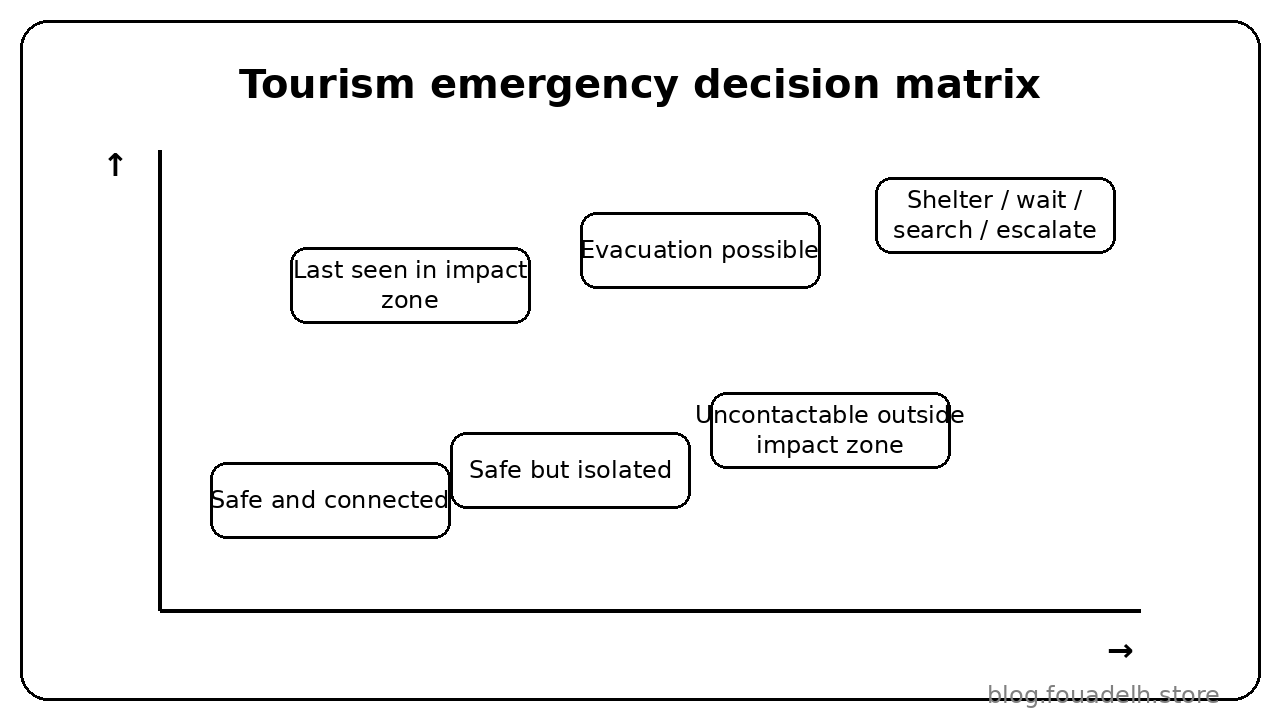
Within 24 hours review route authorization, welfare, evacuation and cancellation using a common status table. A defensible decision then asks three questions: what is known, what could still change, and which action remains safe if the uncertainty resolves badly? “A 24-hour operator and consular playbook” should be revisited after material new evidence or terrain change. During the emergency, reversible precautions are often preferable; irreversible reconstruction or investment choices deserve a stronger evidence threshold. That approach serves the reader need to turn the 2026 disaster into practical operating rules for tourism businesses, guides, travelers and consular responders. and aims to reduce the time needed to account for people, warn groups, reroute trips and support families during a transboundary mountain emergency.
Opened and read evidence: S8 · UNDRR · S11 · World Bank · S2 · Reuters
Decision and verification checklist
Each control needs expected evidence and a defined action when the check fails. These items stay tied to the article’s reader job rather than a generic disaster template.
Use last-known-safe checkpoints rather than default continuous tracking. Measure safety or service outcome rather than administrative activity.
Define missing, uncontactable, stranded, evacuated and safe statuses before a crisis. Assign an owner, due date and observable success evidence.
Delegate route cancellation authority to guides under predefined conditions. Retest after a material terrain, season or staffing change.
Brief visitors on evacuation cues before entering narrow valleys. If evidence is missing, preserve the uncertainty and choose a reversible precaution.
Keep offline passenger and itinerary manifests. Measure safety or service outcome rather than administrative activity.
Assign one liaison for families and consular agencies. Assign an owner, due date and observable success evidence.
Treat route status as conditional and time-bounded. Retest after a material terrain, season or staffing change.
Do not equate insured helicopter rescue with guaranteed evacuation. If evidence is missing, preserve the uncertainty and choose a reversible precaution.
Publish corridor-specific recovery status rather than blanket claims. Measure safety or service outcome rather than administrative activity.
Protect passport and traveler data during reconciliation. Assign an owner, due date and observable success evidence.
Pre-position shelter, water and communications for delayed evacuation. Retest after a material terrain, season or staffing change.
Exercise tourism boards, guides, operators and consular teams together. If evidence is missing, preserve the uncertainty and choose a reversible precaution.
Related campaign articles
- Rebuilding after a $4–5 billion shock: a decision framework for resilient recovery in Nepal
- دليل عملي للاستعداد للسيول الجبلية في نيبال: الإنذار والإخلاء واستمرارية الخدمات



Comments
No published comment yet.
Sign in to comment